Every few days, new hashtags on X/Twitter populate the trending list. Sometimes, the majority of posts tend to focus on one thing, a specific event, or support for a particular story, pointing to a nation where one thing is trending more than anything else across the whole community. But have you ever wondered whether the real facts may tell a different story?
On social media, there are two kinds of activity. The first, called organic, describes people posting naturally about a specific thing. On the other hand, the second is coordinated, as its name suggests, and is described as activity that happens when groups of people push the same message or narrative on social media. In organic activity, different individuals belonging to various regions react to posts independently, while coordinated activity involves the planned behavior of people set to spread a specific message intentionally. This guide helps you understand how to spot organic and coordinated activities on social media.
What is organic vs coordinated social media activity?
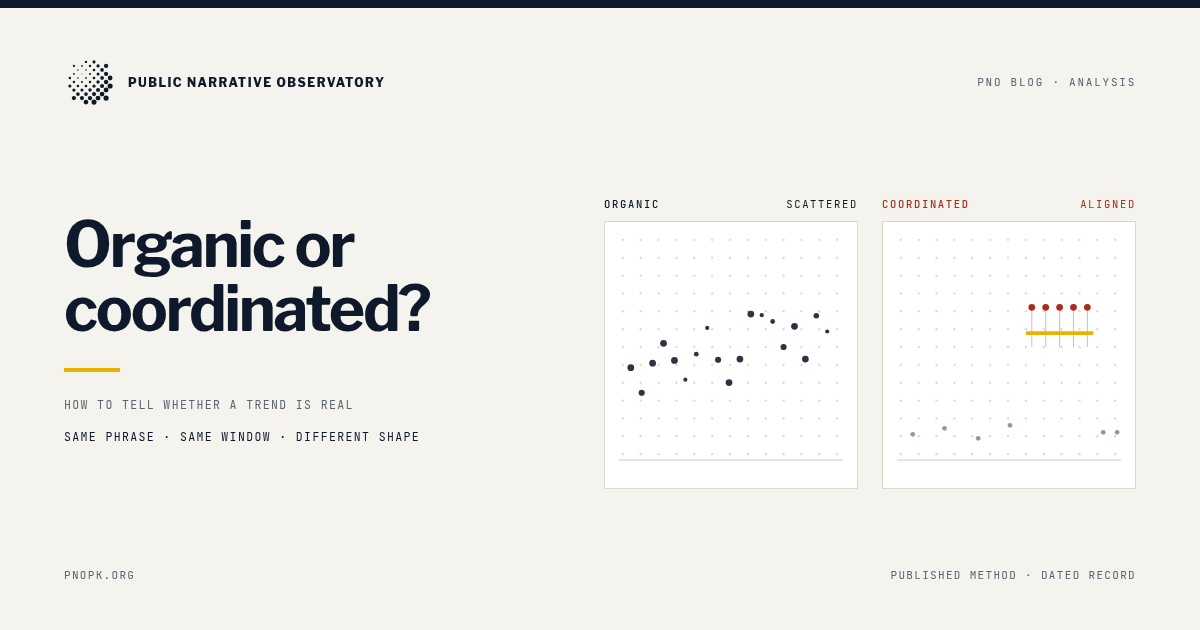
Organic activity is what happens when people naturally participate in social media discussions, sharing their personal views, reactions, and support for real events based on what they like or dislike, at different times and on different occasions. Organic activity features varied formats, wording, and posting cycles, and grows or fades away as new trends emerge on social media.
Coordinated activity is when a group of people builds a specific phenomenon, story, or narrative across different but similar accounts. Such accounts often use similar behavior, wording, resources, and links or images to promote, like or dislike, or reinforce specific social media narratives.
Organic:
- Posted by: Random people, personal views
- Timing: Uneven, follows trends
- Wording: Natural, random
- Growth: Slow, natural slope
- Spread: Natural growth, likes, and shares
Coordinated:
- Posted by: People acting together
- Timing: Bursts, often linked
- Wording: Repeated, identical
- Growth: Sudden spikes, fades away quickly
- Spread: To be shared by group of people
One important point: Coordinated doesn’t always mean fake news. Real people and accounts, such as supporters of a party, can coordinate and push a real event or message. We should be clear about one thing: Rather than asking whether a campaign involves coordinated behavior, we should ask whether the campaign is genuine or entirely fake.
Why does this matter in Pakistan?
Trends on social media can alter how people, the government, or the media respond to a specific event. A Dawn investigation shows that real people support the spread of social media campaigns in Pakistan, supporting specific hashtags to achieve trending spots quickly. Then, there are services offering plans to help parties, groups of people, or businesses manipulate social media trends by posting, sharing, or reacting to specific narratives on social media platforms.
However, we cannot declare whether a trend is real or fake/coordinated until we find out how it was formed and spread, which basically differentiates between organic and coordinated activity. A trend alone doesn’t prove that it’s real, nor does it prove public approval or opinion, or whether it is organic or coordinated without confirmation.
How can you tell if a trend is organic or coordinated?
Let’s find out what you need to check if you’d like to see whether a trend is organic or coordinated on social media.
- Check the timing. Look at when posts start appearing on social media. Organic campaigns rise naturally at peak events and fade away when mass interest decreases.
- Look for repeated wording. People can post differently about the same event. A big sign: natural wording or the use of resources indicates organic activity, while similar messages, resources, or an identical set of hashtags point towards coordinated campaigns.
- Compare amplification with original content. Trending posts can get comments, likes, and shares, and if they are coordinated from a specific angle or by a group of accounts, this can point towards coordinated campaigns. Accounts involved in coordinated campaigns take advantage of posts, content, or trending accounts because they are favored by algorithms.
- Look at the accounts. Check if an account is relevant. For example, an account created recently that starts posting about a specific event may have a fake identity. Similarly, an account posting content that is irrelevant to what its bio says is a sign of an account participating in coordinated campaigns. In this case, the age of an account, niche, and posting angles play an important role for fact-checkers.
- Look at who amplifies whom. Organic campaigns involve people from different niches, regions, and interests. They were not previously connected, had not shared anything, or met in any case.
- See whether outsiders join in. In reality, coordinated campaigns can reach genuine people or audiences. Well, the difference is that coordinated content doesn’t reach a genuine audience in most cases. The reverse is also possible: a coordinated campaign can reach a new audience, but this doesn’t prove the campaign is real.
- Check the volume at the peak. A hashtag, content production, or the spread of similar content alone doesn’t mean the campaign is coordinated. This is possible in reality: many people from different backgrounds can suddenly start posting about one thing. However, the difference is whether or not a specific narrative is mostly circulated by a specific group of accounts.
Worked example: how a narrative formed after Bilawal Bhutto Zardari’s press conference
On November 17, Bilawal Bhutto Zardari shared his opinion on a referendum on new provinces at the Karachi Press Club. He also said that some “backdoor” sources can change how clean decisions are made. Bilawal’s narrative spread on X/Twitter very rapidly within hours. We, the PNO, investigated the narrative, analyzed who pushed it, how it spread, and what caused its spread to stop. Let’s find out, without flagging individual accounts involved in the campaign.
Here is what PNO looked at for this case:
What was said first, and what followed?
The government wasn’t happy with Bilawal’s double standard. At 7:14 PM, hashtags started circulating, discussing Bilawal’s relations with Maulana Fazlur Rehman. In this case, the hashtags appeared in 3,100 posts, where one thing we noticed was that 55% of the hashtags were amplified by accounts whose past posts favored the military. Such accounts mean that their posts across 30 days were specifically meant to praise the armed forces. Moreover, 63 accounts were found posting the video later.
Which narratives spread, and who spread them?
An intimate deepfake video, featuring or purporting to depict Bilawal, circulated in two cuts on November 18, from 5:50 PM. Regardless of what the video is about or whether it features a person, here is what we found by analyzing the X activity from November 17 to 21.
- The video started circulating at a high speed; a 30-second cut was uploaded eight times. The accounts posting the video belonged to groups supportive of the military. Some small accounts also participated; eight of them posted the video with different wording, captions, and durations. The video was reposted 27 times.
- There were five accounts, created between April and August 2026, whose posting activity seemed suspicious. They appeared to be defense-related pages and posted the 15-second cut. Then, PTI-aligned and JUI-F-supportive accounts carried it to ~680 accounts, yet seemingly caused the spread unintentionally, allowing them to flag the video as fake footage. This ratio is 7x wider, and they blamed the establishment or asked if the video was real.
When did it stop being talked about?
The video suddenly stopped circulating. 92% of posts featuring the first cut of the video appeared within 24 hours, ending by noon on November 19. The second cut started disappearing on the morning of November 20, and none of the cuts appeared after November 21.
Conclusion: (What this shows)
The story circulated in a way that suggested a coordinated campaign, due to the video’s first cut circulating rapidly and at specific times; however, the stats don’t establish whether the story was a confirmed “coordination effort” or who was behind it. Following the first cut, the video’s second cut was largely circulated through organic reach.
What can’t be proven?
This is the part most guides skip.
- No sign is proof on its own. Even organic content can seem like part of a coordinated campaign, such as real messages shared repeatedly, real people participating in a similar manner, or sudden traffic spikes around the same narrative.
- Ground truth is scarce. It’s normal if we are unable to figure out if a campaign is real or fake. Above all, a set of rules can be true for one thing while pointing to another.
- Coordinated accounts adapt. Coordinated accounts have become smarter than before. There are now automations as well, helping them adapt natural behavior while still supporting coordinated patterns; yet they are hard to spot. Such assumptions are also supported by studies.
- Good methods use a comparison group. While we can compare different factors when assessing campaigns, no set of rules can genuinely determine whether checking a list of factors is proven to work and help spot organic or coordinated campaigns. In the end, what happens after the event can help clarify whether the event was part of a coordinated campaign.
- Coordination is not the same as who is behind it. Even if a coordinated campaign is spotted, it doesn’t tell you who is behind it.
So, what else? The reason why PNO features its method, date, and findings with pointers is clear enough: “Everything needs a follow-up: how it emerged, faded away, and shaped perspectives”. We keep stories under observation, using thresholds rather than assumptions to flag coordinated campaigns, and we sincerely clarify if a piece of information is missing or not tracked well enough to make a decision. See how we work on the ++About page++.
How can you check a trend yourself?
- First, you have to note which hashtag or phrase is circulating and also when it started to emerge.
- Next, make a note of which sample posts, patterns, or trends/messages started appearing first, at peak hours later, and on the next day.
- The fun part: you can quickly spot if the posts contain repeated patterns, wording, or planted messages. Look at the content you have previously shortlisted in the above step.
- Spot active accounts and the people who participated in the majority. Also, check if the accounts were created recently and what they usually post on their profiles. You can manually carry out the mentioned routines.
- Important: See what discussions or events were happening offline when a campaign broke out online. This requires homework in real life.
- Finally, without blaming or flagging individual accounts, write down what you’ve noticed, which patterns occurred, what happened after the event, and what else you can finally conclude. Remember, you don’t have to spot, pinpoint, or name individual accounts for privacy purposes.
We support ++live++ observations on PNO, helping you track, assess, or see real discussions and happenings. Similarly, we invite you to learn from real cases, or find out where a resource or image first appeared in Tools. You can also ++report a campaign++ if you think your findings are valuable.
Frequently asked questions
Is a coordinated campaign always fake?
Coordination, as its name suggests, implies a group of people active in the same direction and working together. We can flag it as a coordinated campaign if the people participating in a campaign are fake, the accounts were recently created, or they support a single narrative with repeated patterns of the same message.
Are Pakistan’s trends paid for?
Studies show that Pakistani media can feature paid campaigns. However, not all coordinated campaigns are paid. Based on several patterns, we can determine whether a campaign is organic or coordinated, yet we may have no proof to make a specific conclusion.
Can a trend be both organic and coordinated?
Yes. A campaign that started as a coordinated one can spread the word so naturally that real people start spreading the story.
Do bots run these campaigns?
Not necessarily. Real people can initiate a coordinated campaign, as reported in the Dawn investigation.
Conclusion
News, especially politically driven narratives, spreads rapidly online. Narratives form within hours, yet leave no clues as to whether they are organic or coordinated. At PNO, we help our audience explore data, posting schedules, and the waves of activity where narratives are shaped, and we leave conclusions to our audience, so they can assess for themselves whether narratives online in Pakistan make sense.
Make sure to clearly state the findings, say if you have no information about something specific, and always analyze various factors to determine whether a campaign was coordinated. You’ll need to see whether the days after the event became genuinely noticeable.
PNO, in this case, publishes findings with its method and date. This helps users assess how PNO’s data can help figure out something specific. To see more data, request early access to the PNO database and to learn more about its findings in the Pakistani landscape.